AI makes ERP configuration faster – but does it make the processes any clearer?

More than 70% of recently implemented ERP initiatives will fail to fully meet their original business goals by 2027, according to Gartner. AI will make the technical side of those projects faster. The question is whether it fixes the reasons they fail.
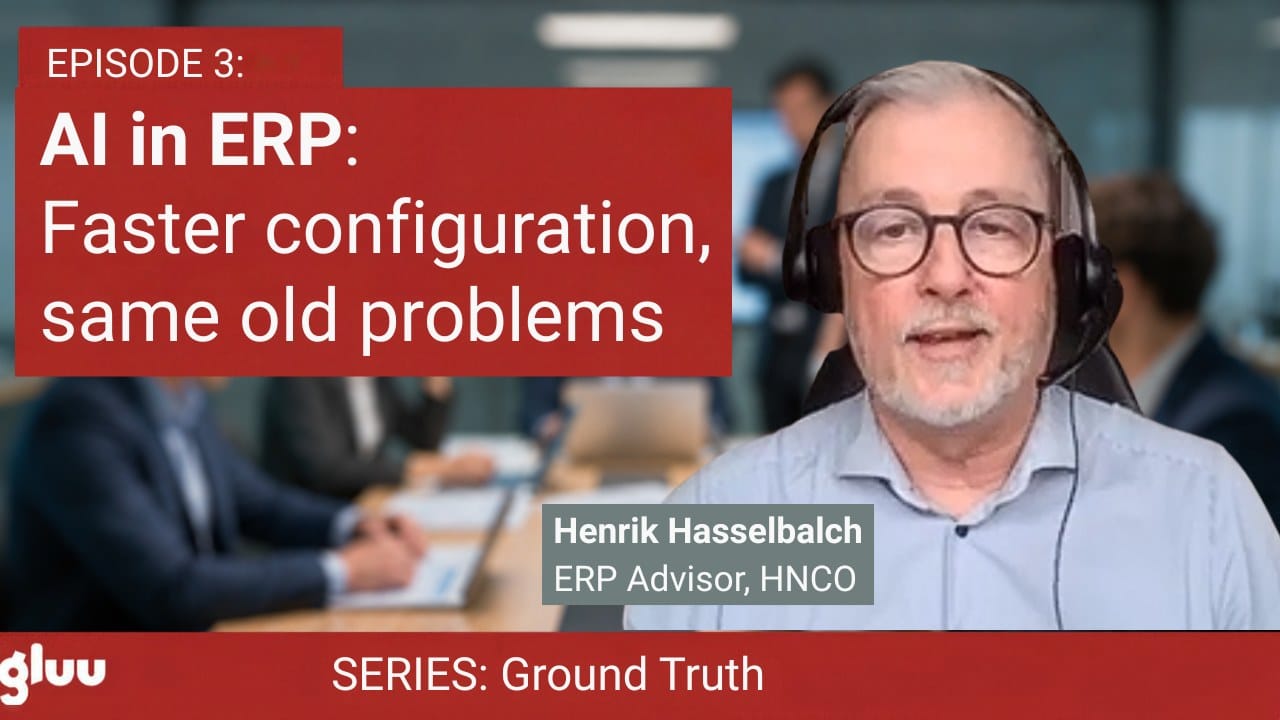
The short answer from Henrik Hasselbalch of advisory firm HNCO, who has worked with ERP for 35 years on both the vendor and the advisor side: “Not at all. I think AI makes your unclarity faster.”
This article is based on a Ground Truth conversation between Henrik Hasselbalch and Søren Pommer. Henrik has worked with ERP for 35 years, on the supplier side at companies such as SAP, Oracle and IBM and as an advisor.
Key takeaways
- AI condenses configuration, testing and data conversion. It does not change decision-making, clarity or onboarding.
- ERP projects get stuck on decisions about how the business wants to work, not on software.
- Adding AI to an unclear project accelerates it – towards a “high speed catastrophe”.
- Spend part of the time AI saves downstream on clarity upfront: processes, decisions and the data model.
- Start with one concrete area, such as testing, and use AI there at full scale from day one.
- Keep humans in charge of critical decisions: performance evaluations, financial disclosure and pricing.
Watch the full conversation with Henrik Hasselbalch from Gluu’s Ground Truth series. The written version below covers the main points.
Does AI make ERP implementations faster?
Yes, in the technical phases. Henrik’s firm HNCO is currently surveying large ERP vendors and implementation partners about where AI changes the size and speed of projects. “They all say almost the same thing,” he says. “Everything that relates to configuration, tests, data conversion… will actually be super condensed in the future.”
What does not change is “the problem that we just talked about, about clarity, about direction and getting people to onboard the new ways of working… they will not be challenged by any tool that you can put into it.”
| Part of an ERP project | Effect of AI (per vendors and partners surveyed) |
|---|---|
| Configuration | Strongly condensed |
| Testing | Strongly condensed |
| Data conversion | Strongly condensed |
| Decisions on how the business should work | Unchanged |
| Process and data model clarity | Unchanged |
| Getting people on board | Unchanged |
Where do ERP projects really get stuck?
On decisions. “Where we really see the challenge that is in decision making about how we want to work and decision making about how we drive our business,” Henrik says. People bring their own view of how things work; put those views side by side “it becomes obvious that you don’t have the same view and you don’t have that clarity”.
Without clarity, decision-making and “a route to escalate”, that is “where the real problem starts”. The software itself rarely is: “The real problem sits in the human interface with the system versus the world they want to operate in.” See also why ERP implementations fail.
What happens when you add AI to an unclear ERP project?
You go faster in the wrong direction. Henrik borrows an image from a leading ERP industry figure: putting AI into an insufficient process, “it’s like putting a Ferrari engine onto a broken bike”. AI is good at handling large amounts of information and complexity in parallel, “if the direction is not clear, then you just… get an accelerated or speedy way towards the abyss.”
He calls AI “the most disruptive tool for an ERP project I have ever seen”. The risk is in how teams spend the time it saves. Projects classically spend a small share of time upfront and most of it downstream on technical work. If teams take the full downstream saving and do not spend more time on clarification, Henrik expects projects that end in what he calls a “high speed catastrophe instead of a catastrophe”.

“How do we identify the value creation in our processes? Which piece of the process are really differentiating us towards the world? And all of these things, you don’t get that from an AI model.”
Henrik Hasselbalch, ERP Advisor, HNCO
What separates successful ERP implementations from failed ones?
Henrik lists the factors in order of magnitude. Of these characteristics he says “they’re always in place when you have catastrophic projects”, and the more of them there are, the bigger the catastrophe.
| # | Failure factor | What successful projects do instead |
|---|---|---|
| 1 | Lack of decision-making and leadership | Leaders stand by the decision to work the standardised way when real life gets difficult |
| 2 | Legacy customisations carried over | Clean house: keep only what makes the business different |
| 3 | Data model clarity left too late | Decide which data moves “really, really upfront and not just like two weeks before go live” |
| 4 | The human side underestimated | Plan testing, onboarding and change management properly |
What should an ERP project leader use AI for first?
One concrete area, not many. Henrik’s suggestion is testing, which is “always underestimated massively” in estimates: component tests, integration, regression and UAT. Decide from the start of the project to use AI “full scale for the test”, with test scripts generated from the requirements. That way “you will get the experience about where you can use AI and where you shouldn’t.”
The prerequisite is the same as for the project as a whole: “Get your house in order” – understand your high-level processes down to a certain level. “With AI, as I said, you put steroids onto a catastrophe if you don’t have that from the beginning.” More for ERP project leaders.
Can AI work out what good looks like from your existing documentation?
Not safely. First, people disagree more than they think: asked whether two people in the same organisation can describe the same process and mean the same thing, Henrik answers “almost not”.
“It’s really amazing how different people see the reality that they both operate in and maybe have done it for years.”
Henrik Hasselbalch, ERP Advisor, HNCO
Letting an AI read all the work instructions and legacy material to “figure out what the good looks like” carries “a high percentage of likelihood that it would invent things that you don’t want”. At the scale of a large organisation, “you could sit on a bomb”. Agreement on what good is has to come first – see process clarity before ERP implementation.
What do you lose if the implementation partner holds your process knowledge?
Little, for the efficiency part of the business – what Henrik calls the system of records. “It doesn’t matter too much if you take away all the tedious work and leave that with the vendor… But keep your differentiating knowledge.” Standard areas such as financial processes will become more standardised and largely the vendors’ domain. The processes that make you different stay yours.
Which ERP processes should never run unsupervised by an AI agent?
Those with critical decisions in them: “people performance evaluations or financial disclosure or pricing on a project or an offer”. Identify which processes are critical once you have a view of how your processes look, and stay “very much on top of your agents”, because “there are some hallucinations going on sometimes”.
His one-sentence advice to a leader about to start an ERP project is short:
“Never underestimate the human side.”
Henrik Hasselbalch, ERP Advisor, HNCO
Gluu free 30-day trial. No credit card required. Start from €24 / year.
More from Ground Truth Season 1: why AI pilots fail to scale (with Michael Hansen), why AI usage is not the same as change (with Irina Holt Christensen) and where an organisation’s intent actually lives (with Etienne Venter).
FAQ – AI in ERP implementation
Yes for configuration, testing and data conversion, which vendors and implementation partners expect to be strongly condensed. It does not speed up decisions, process clarity or getting people on board.
In decision-making about how the business wants to work, when different people hold different views of the same process and there is no route to escalate.
It accelerates the project in an unclear direction. As ERP advisor Henrik Hasselbalch puts it, AI makes your unclarity faster.
One concrete area such as testing, used at full scale from the start of the project, once the high-level processes are clear.
In order of magnitude: lack of decision-making and leadership, carrying over legacy customisations, leaving data model decisions too late, and underestimating the human side.
Processes with critical decisions in them, such as people performance evaluations, financial disclosure and pricing.
Not safely. Without agreement on what good looks like, it is likely to invent rules you don’t want.